
Creative Aging Is Healthy Aging: How to Make the Case
If you're making the case for creative aging, there's a growing body of research ready to support you. The key is knowing where to look, and how to talk about it.
The False Binary: Basic Needs vs. Enrichment
In many Western models of wellbeing, there’s a persistent idea that our needs follow a straight line—from survival to fulfillment. This belief, rooted in psychologist Abraham Maslow’s “Hierarchy of Needs,” suggests that we must secure “basic needs” like food, shelter, and safety before we can truly experience “higher needs” like belonging, creativity, or purpose. This hierarchy has been used by policymakers, funders, and health experts alike as a kind of priority list for deciding how to address individual and social problems.
In many ways, this pyramid framework is comforting, offering an orderly, clear starting point to build upon. But real life is rarely that linear. As we’ve seen in recent years, health and wellbeing are deeply interconnected. In reality, human life looks less like a hierarchical pyramid and more like a holistic pie. We live webs of relationships, conditions, and experiences that contribute to our overall wellbeing.
Consider the person juggling multiple jobs who lacks time for rest or connection, versus an entrepreneur embracing financial uncertainty in pursuit of a dream. Or someone living with chronic illness, whose life falls outside of conventional definitions of health and productivity. Are these lives less “actualized” because they don’t fit the pyramid? What about individuals living in poverty or navigating systematic barriers—are they less entitled to purpose, expression, or joy?
To be clear, meeting the health and safety needs of everyone is an essential mandate for any society. But multi-faceted problems require multi-faceted solutions. Creative expression, social connection, storytelling, and cultural participation are not afterthoughts; they are valid, evidence-supported ways to promote wellbeing, especially as we age. We must expand our collective imagination around health and wellbeing to recognize their value and incorporate them into our perception of core human needs.
Creative expression, social connection, storytelling, and cultural participation are not afterthoughts; they are valid, evidence-supported ways to promote wellbeing, especially as we age.
“Basic” needs and “higher” needs are not mutually exclusive. We now have strong evidence that social connection improves physical health, that creative expression reduces stress (a known contributor to chronic illness), and that cultural engagement reinforces identity and belonging—especially in marginalized communities. These aren’t abstract ideas—they’re data-backed, human-centered practices with measurable outcomes.
If you’re making the case for creative aging, there’s a growing body of research ready to support you. The key is knowing where to look, and how to talk about it.
Understanding the Creative Aging Evidence Landscape
When building a strong case for creative aging programs, it’s important to understand the type of studies on arts participation that exist, and how to translate their findings into language that inspires action. A broad and growing tapestry of evidence points to the benefits of creative engagement to healthy aging. This research spans several related fields: arts education, art therapy, and arts in health. Much of the evidence that directly supports creative aging is being uncovered by the arts in health field, focusing on how cultural and creative activities promote health, wellbeing, and quality of life.
In health research, there’s something called the, “evidence hierarchy.” It offers a way of ranking evidence according to how well it shows cause and effect. At the top are types of reviews called evidence syntheses, which combine results from many different studies on the same topic. Next are studies where scientists collect new data themselves. The strongest of these are Randomized Control Trials (RCTs)—studies where participants are randomly assigned to receive an intervention or not, and the outcomes are compared.
Below RCTs are:
cohort studies (following groups of people over time);
case-control studies (looking back to compare people with and without a certain health outcome)
cross-sectional studies (snapshots of a single population at one point in time);
case studies (in-depth looks at individual people or programs)
expert opinion (evidence based on someone’s experience)
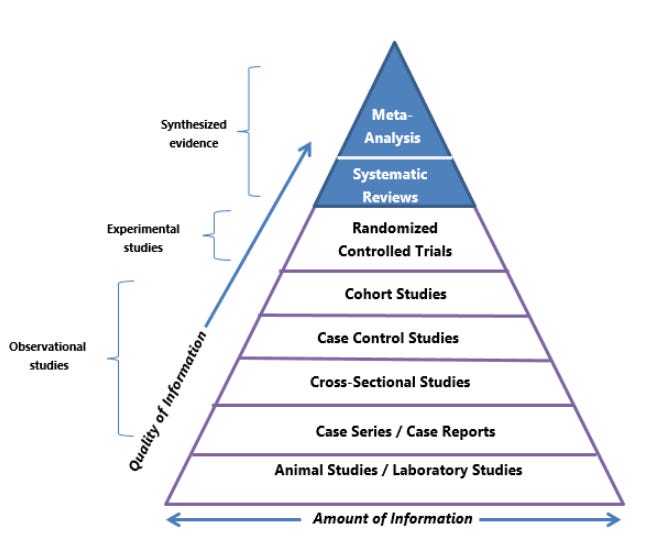
But this hierarchy has limits. RCTs work well in medicine, but are harder to apply to creative participation. For example, you can’t easily “blind” participants to creative activities or fairly withhold them from participation for control groups.
That’s why case studies and expert opinion are so valuable to this field—the qualitative data from this type of research can capture lived experiences, show barriers and support for participation, and highlight real-world impacts that numbers alone might miss.
Each kind of evidence contributes something important, from the nuance of personal stories to the broad patterns revealed in large studies. Next, we’ll take a closer look at cohort studies that follow groups of people over time. Because of their scale and scope, these studies provide powerful insights into how creative participation affects aging and can strengthen the case for creative aging programs.
How Creative Aging Supports Health: Findings from the EpiArts Lab
Since 2020, the EpiArts Lab—a National Endowment for the Arts Research Lab and collaboration between the University of Florida’s Center for Arts in Medicine and University College London’s Social Biobehavioral Research Group—has been studying how creative engagement affects health over time. A big part of the lab’s work involves the use of data from cohort studies—long-term survey data from thousands of people tracked over many years—to see how their health and wellbeing change over time. Researchers then look at how taking part in creative activities connects to things like mental health, physical health, and quality of life. This work has led to over 20 published studies so far.
Here are some key findings from recent published studies that support the benefits of creative aging:
1. Study Theme: Creative Activities and Depression
What they studied: Data from 19,134 adults age 50+ in the U.S. (2008–2016)
What they found: Older adults who engaged in creative activities were 20% less likely to experience depression, both immediately and two years later.
Why it matters: Consistent creative engagement can be a protective factor for mental health.
How you can use this: The study found that regular participation matters—monthly programs made a real difference, and weekly programs had the strongest benefits. If mental health is a priority for your funders or leaders, this evidence supports investing in ongoing programs rather than one-off drop-in sessions.
2. Study Theme: Creative Activities and Healthy Aging
Title: Leisure Engagement in Older Age is Related to Objective and Subjective Experiences of Aging
What they studied: Data from 8,771 adults age 50+ in the U.S. (2006-2018).
What they found: Older adults who engaged in creative activities more frequently showed better daily functioning, fitness, sleep, and overall feelings of health over time. Creative activities had more consistent benefits than community or cognitive ones, but physical activities showed the strongest impact.
Why it matters: Creative activities don’t just make people feel better—they keep people healthier, longer.
How you can use this: Creative aging programs should be framed as part of the strategy to support healthy aging. Use thisresearch to advocate for, design, or expand community programs where creative engagement is understood to be a health behavior like exercise.
3. Study Theme: Creative Activities and Cognition
What they studied: Data from 4, 344 adults in the U.S. that was collected once in 2004 when most were 63 years old and again in 2011 when most were 77.
What they found: Both participatory arts (creating art, music, or crafts) and receptive arts (attending concerts, plays, or museums) for up to one hour per week were associated with better executive function and language abilities, including reasoning and verbal fluency, seven years later. People who spent up to three hours a week also had better memory.
Why it matters: Even small amounts of creative participation may protect thinking and memory as people age.
How you can use this: Encourage steady, weekly participation in your programming as a tool for brain health, including both receptive arts like concerts and hands-on art classes.
4. Study Theme: Creative Activities and Use of the Healthcare System
Title: Social, Cultural & Community Engagement (SCCE) and Healthcare Use
What they studied: Data from 12,412 adults aged 50 and older
What they found: Higher engagement in social, cultural, and community activities was linked to fewer hospital stays and nursing home admissions. It was also tied to more routine healthcare use like outpatient visits and dental care.
Why it matters: Creative engagement can spark a virtuous cycle of health behaviors that encourage preventive activities while reducing more expensive interventions.
How you can use this: Results showing both cost savings and healthier aging are great for making the case for the value of creative aging programs. Use this kind of data to help funders, policymakers, and community organizations see the return on investment.
Building a Case That Connects: Insights from the Co-Directors of the EpiArts Lab
Dr. Jill Sonke of the University of Florida and Dr. Daisy Fancourt of University College London—the co-directors of the EpiArts Lab—are experienced at using data to connect health outcomes to creative participation.
For Dr. Sonke, the EpiArts Lab’s evidence shows the value of resources already around us, from structured creative aging programs to everyday acts of creativity. The key is helping people see creativity as a health resource, much like diet and exercise. She stated:
“(Arts and culture) resources are not only available; they’re underutilized because they’re under-recognized. But they’re especially meaningful because they’re local. They’re available all around us—in our homes, in our neighborhoods, in our communities.”
Hear From Arts & Health Expert: Dr. Daisy Fancourt
Dr. Daisy Fancourt explains social prescribing, the effects of arts on our health and well-being, and how the ArtLift program in Gloucestershire, UK benefited an older adult with physical and mental health challenges (participant story begins at 4:50).
In the United Kingdom (UK), decades of grassroots activity and supportive policies have helped weave the arts and culture into the country’s health and social care system. For the past ten years, social prescribing—where clinicians “prescribe” non-medical services to address health conditions driven by social or lifestyle factors—has been an official part of the UK’s National Health Service. Community arts and cultural programs are some of the most prescribed activities. Dr. Fancourt explained how data helped drive this change:
“Places like the Bromley by Bowe Center in East London, which was one of the early pioneers of social prescribing, and the ArtLift program in Gloucestershire, which again was an early pioneer of arts on prescription through GPs [Primary Care Physicians] these gathered a lot of interest…they established their own evaluations of their programs that showed impact and also some cost effectiveness, and this really helped to interest people in developing other local pilots.”
After experiencing a severe stroke and subsequent depression, Russell, an older adult, was referred by his doctor to the ArtLift program when medications alone were not providing relief. Dr. Fancourt described the powerful impact the program had on his recovery:
“Over a period of weeks, he started to see benefits: he was no longer needing help with his sleep, he was able to reduce the medication he was on—until he was off it completely. In fact, he discovered a real talent for painting and was commissioned to do exhibitions of his work.”
Dr. Fancourt also mentioned that Russell began running his own painting sessions in his community for others who dealt with physical and mental health challenges.
Both Dr. Sonke and Dr. Fancourt stress that the strongest case comes from combining multiple kinds of evidence. “No data without a story, no story without data,” Dr. Sonke said, quoting Randy Cohen, Vice President of Research at Americans for the Arts. Statistics appeal to logic, but stories make findings relatable. Together, they are far more compelling.
“I think it’s definitely a combination of qual(itative) and quan(titative),” she continued. “Stories are incredibly important for their relatability. When we tell stories, people can see themselves in it, bring their own humanity and their own life experience to an issue. Whereas when we present our statistical findings, we’re really appealing to logic and cognitive functioning. And we know that can be important and meaningful, but when we pair it with personal stories, I think those funders, policymakers…whoever we’re speaking to (can) bring themselves more holistically and the information is so much more compelling.”
For Dr. Fancourt, combining different types of data is a key next step in advancing arts for health in the United States (U.S.). “The UK has been very strong now in triangulating evidence from case studies, from running specific RCTs, from having epidemiological data, from thinking about implementation science, and thinking about cost and cost effectiveness. And I think that triangulation of different types of evidence is proving really valuable. I think that we’re already seeing some of that transfer through the EpiArts Lab.”
Supporting Creative Aging in Different Healthcare Systems
While the U.S. can learn from other countries like the UK, Dr. Fancourt noted that its more privatized healthcare and arts systems mean it will also need to forge its own path.
Within a private healthcare system, insurers look for direct financial returns on investment. By contrast, in the UK, savings can be distributed across education, pensions, or other sectors—not just in healthcare. This means U.S. advocates need to measure not only health outcomes but also direct economic impacts.
Dr. Sonke also notes that arts are often seen as “luxuries” in the U.S.. Research can shift this perception by showing the everyday health benefits of creative engagement and by expanding opportunities to participate regularly. These shifts—both in perception and access—are essential for advancing creative aging.
Bringing Research and Practice Together for Impact
Creative participation in older adulthood is more than a “nice to have”—it is a vital tool in our healthy aging toolbox.
There are as many ways to demonstrate its value as there are artistic mediums, and a growing body of quality evidence affirms its impact on our health. Creative aging practitioners can strengthen the case by:
Using research to inform advocacy and program design.
Partnering with researchers on projects and/or including robust evaluation in grant applications.
Sharing best practices and results with peers.
These contributions expand the pool of reliable data, and strengthen our shared understanding of how to make programs most accessible, equitable, and effective. By learning from each other and building on what works, we move closer to a future where individual and collective creativity is truly nurtured across the lifespan.
Ready to showcase your work at the intersection of arts and health? Let us help you lead the way through creative aging. Connect with us today using the form below!
Meet the Author: Nicole Morgan
Nicole Morgan is an arts in health researcher and Research Manager at the University of Florida Center for Arts in Medicine. She leads and coordinates national and international research programs and initiatives such as the Interdisciplinary Research Lab, the EpiArts Lab, and One Nation/One Project. Her work focuses on assessing the impact of arts and cultural practices on the health and wellbeing of individuals and communities, across the lifespan.
Resources
Leisure Engagement in Older Age is Related to Objective and Subjective Experiences of Aging (2024): Researchers looked at data from nearly 9,000 U.S. adults over age 50. They found that older adults who regularly did creative activities had better health—things like daily functioning, sleep, and overall well-being—over time. Creative activities helped more consistently than social or brain games, though exercise still showed the biggest health boost. The takeaway: creative aging programs should be seen as part of healthy aging, just like physical activity.
Participatory and Receptive Arts Engagement in Older Adults: Associations with Cognition over a 7-year period (2023): Researchers followed over 4,000 adults from their early 60s to their late 70s. They found that doing or experiencing the arts for just 1–3 hours a week was linked to stronger memory, reasoning, and language skills years later. Even small, regular doses of creativity can help protect brain health as we age.
Engagement in Leisure Activities and Depression in Older Adults in the United States: Longitudinal Evidence From the Health and Retirement Study (2022): Researchers studied data from over 19,000 U.S. adults age 50+ and found that those who took part in creative activities were 20% less likely to experience depression. Regular participation mattered—monthly programs helped, and weekly ones gave the strongest mental health benefits, showing why ongoing programs are more effective than one-off sessions.
Social, Cultural & Community Engagement (SCCE) and Healthcare Use (2023): Researchers studied over 12,000 adults age 50 and older. They found that people who took part in social and cultural activities had fewer hospital and nursing home stays, while also keeping up with regular care like doctor and dentist visits. Creative engagement not only supports healthier aging but can also save on healthcare costs—powerful evidence to share with funders and policymakers.
Thanks for reading The Creative Aging Resource Journal from Lifetime Arts! Subscribe for free to receive the latest issues directly in your inbox. Want to support the publication of this journal? Make a contribution today.
This is such an important and well-argued piece. I’m continually inspired by the work Lifetime Arts is doing to advance creative aging—not only by building programs, but by helping to shift the larger conversation around what it means to age well. The research you highlight here makes a powerful case for why creative engagement belongs at the core of healthy aging, not just as enrichment but as a fundamental part of wellbeing.
As Teaching Artist who participates in and advocates for this work, I’ve seen firsthand the transformative impact creative opportunities can have, both for individuals and communities. Thank you for providing such clear, actionable insights for anyone making the case for creative aging. I’m proud to support this movement and look forward to seeing it grow.
Hi! I am so happy to have found this article. I am an occupational therapist in NY and love bringing art-making & creativity into my work with clients of all ages. I will be following…I am looking for ways to be involved in this work outside of the traditional medical/educational model, which has a hard time billing for all the ways creativity affects our health and the health of our communities. Glad to be here and thank you!